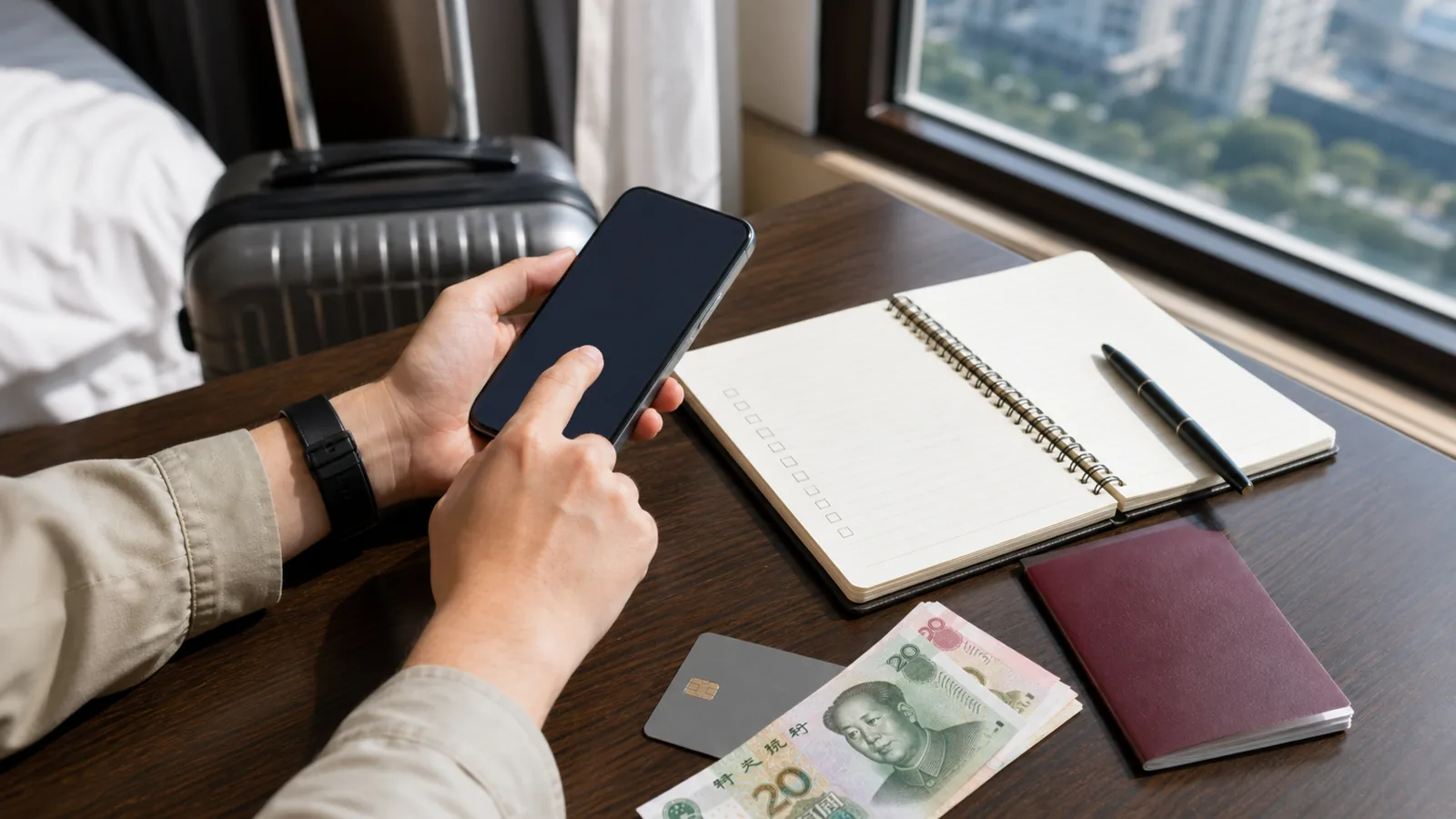
The Shanghai section focuses on the moments when international arrivals most often need a practical next step: getting online, choosing the right rail system, paying at a machine or gate, and finding staffed help when self-service fails.
Keep the information you will need before the airport Wi-Fi or mobile data works. Save it both on your phone and somewhere a companion can reach. Use the exact Chinese address supplied by your hotel rather than a machine-translated place name.
- Passport and current entry documents
- Flight and hotel confirmation
- Hotel name, Chinese address and telephone number
- Primary airport-to-hotel route and one fallback
- A working data plan, charged phone and power bank
- One mobile payment method plus a card or small RMB cash fallback
Have your passport and current entry documents ready, and follow the instructions shown by the National Immigration Administration and the port you are using. China introduced an online arrival-card option for eligible foreign travelers, but the required process can depend on the traveler and port; check the current official notice instead of relying on an old screenshot.
After immigration, collect your baggage and follow the customs channel that applies to you. Do not rush into a transport offer while you are still reorganizing documents. Move to the public arrivals area, check that your passport is secure, and open your saved arrival plan.
Turn on the roaming, travel eSIM or local SIM plan you prepared. At Shanghai Pudong Airport, the official free network is #AirportPVG-Free-WiFi. The airport lists four connection routes: its WeChat mini program, SMS verification, a kiosk number obtained with a passport, or mobile passport recognition. If one route fails, try another or ask at a staffed counter. A local physical SIM normally requires passport registration at an authorized service point. Connectivity does not guarantee that every app or website is available, so keep essential documents offline.
Open Alipay or WeChat Pay and confirm that the account and linked payment method still load. Make one small, ordinary purchase only if you need to test it. Do not repeatedly retry a declined transaction; use the second payment route or small RMB cash you prepared.
Compare the whole trip from the terminal to your hotel, not only the fare. Airport rail or metro is predictable when it is operating and you can manage the transfer. An airport bus may work when its final stop is close to the hotel. An official taxi rank, app-based Didi pickup or confirmed private transfer is often calmer with heavy luggage, children, reduced mobility or a late arrival.
Follow the current airport signs to the named station, taxi queue or ride-hailing zone. Timetables, last services, pickup areas and fares vary by airport and date. If the planned route has ended, return to a staffed transport desk or official taxi rank rather than accepting an unsolicited ride away from the marked public area.
- Light luggage and operating service: compare airport rail or metro.
- Direct route with a suitable stop: check the official airport bus.
- Heavy luggage or late arrival: use an official taxi rank or confirmed pickup.
- Family, accessibility need or regional airport: confirm vehicle size and meeting point in advance.
A translated ticket-machine screen is not enough if your phone is offline, the station name is wrong, you are at the wrong rail system, or that machine does not accept your payment method. Save your hotel’s Chinese name and address offline, finish your data, account-login and card-linking setup before you fly, and prepare a separate ticket, bank card or QR code for each rider.
Shanghai Metro now has three distinct ways to pay. Eligible contactless UnionPay, Visa, Mastercard, American Express and JCB cards can tap directly at the gate. Every metro station has a service center with a card terminal for buying tickets; the official counter list also includes Discover and Diners Club. Ticket machines are a third channel and may show cash, Alipay or WeChat Pay. The card list for a staffed counter is not the same as the list for tapping directly at a gate.
If a ticket machine freezes or rejects the transaction, stop retrying: move to another machine, then go to the Metro Service Center if it still fails. For groups, use one ticket, card or valid QR code per passenger. Airport Link, Shanghai Metro, the Maglev and intercity trains are separate systems; Pudong–Hongqiao Airport Link takes about 40 minutes and costs RMB 26 end to end, and a transfer to the metro requires a new valid fare method.
| Where you pay | What currently works | What to watch for |
|---|---|---|
| Tap directly at the gate | Eligible contactless UnionPay, Visa, Mastercard, American Express and JCB cards | Enable contactless/small-value payment; use the same card to enter and exit; one rider per card. |
| Buy at a Metro Service Center | UnionPay, Visa, Mastercard, Discover, American Express, Diners Club and JCB | This card list is for buying a ticket at the staffed counter, not a promise that every card taps at the gate. |
| Use a ticket machine | Follow the payment methods shown on that machine, which may include cash, Alipay or WeChat Pay | If the machine fails, change machines or ask at the service center instead of repeatedly retrying. |
| Use a transit QR code | A valid Alipay, WeChat Pay or Metro Daduhui transit code | Each passenger needs a separate valid code. |
For Didi, enter the exact destination and use the pickup zone shown in the app. Before entering, match the vehicle, plate and driver details. In-app messages may be translated; the driver may ask for the last four digits of the phone number attached to the booking. For a street taxi, use the official rank, show the Chinese address and ask for the receipt where available.
Do not follow someone who approaches you with an unofficial fixed-price offer. If the app, data or payment fails, stay in a well-lit public area and use the official taxi queue, airport desk or hotel telephone number as your fallback.
At a hotel, present the passport used for the booking. Hotels complete the accommodation registration for foreign guests as part of check-in. Keep the hotel name and address available in Chinese for later rides.
If you stay in a private home or another place that does not complete hotel registration, China’s National Immigration Administration says the traveler or host should register with the local public security authority within 24 hours. Follow the current local procedure and ask the host to help before arrival.
Once you are checked in, confirm the systems you will rely on tomorrow rather than trying to solve the entire trip at once. Charge your phone and power bank, save the hotel location, test the route to your first stop and place your passport in a secure location.
A short meal and rest are often a better first-night plan than a complicated cross-city itinerary. Tell a companion that you arrived, keep one backup payment route, and check the live transport schedule before leaving again.
- Confirm mobile data and one backup connection.
- Confirm one working payment method and keep a fallback.
- Save the hotel address and tomorrow’s first destination in Chinese.
- Charge the phone and power bank.
- Check live opening hours and transport before going out again.
This guide was reviewed on 24 August 2026 against current State Council, immigration, Shanghai transport and China Railway guidance. Entry procedures, airport transport, accepted cards, mobile services and local registration processes can change. Recheck the applicable official instructions for your travel date, airport and accommodation.
- State Council — A Guide to Working and Living in China as Business Expatriates (2025)
- National Immigration Administration — online arrival card notice
- National Immigration Administration — accommodation registration
- Shanghai Government — 2026 Shanghai Metro guide
- Shanghai Government — contactless bank cards at metro gates
- Shanghai Government — Airport Link travel time and fare
- China Railway 12306 — registration with a foreign passport
- China Railway 12306 — English ticket-booking FAQ
Human-reviewed against current official immigration, Shanghai airport and transport, and China Railway guidance.
Source and review
Last reviewed:
- State Council — A Guide to Working and Living in China as Business Expatriates (2025)
- National Immigration Administration — online arrival card notice
- National Immigration Administration — accommodation registration
- Shanghai Government — 2026 Shanghai Metro guide
- Shanghai Government — contactless bank cards at metro gates
- Shanghai Government — Airport Link travel time and fare
- China Railway 12306 — registration with a foreign passport
- China Railway 12306 — English ticket-booking FAQ
- Shanghai Pudong International Airport — official Wi-Fi connection guide
- Shanghai Pudong International Airport — official service-facilities directory
A China-based planner reads every request.