The source journey began in Xining and reached Chaka Salt Lake after roughly four hours by road from Xining. It also paired the salt lake with Qinghai Lake. For an overseas visitor, that sequence is best read as a corridor with substantial travel time, not as two nearby photo stops.
The account describes grassland, mountain and plateau views changing along the road, which made the transfer memorable in its own right. Keep the same expectation when judging your day: the value is not only the final reflection, and the return journey still needs real time and energy. Confirm the actual vehicle, meeting point and timing for your own date.
Chaka Salt Lake, written 茶卡盐湖 in Chinese, lies in Ulan County in Qinghai's Haixi Mongol and Tibetan Autonomous Prefecture. The Korean report explains that “Chaka” means salt lake in Tibetan and places the lake at about 3,100 metres above sea level.
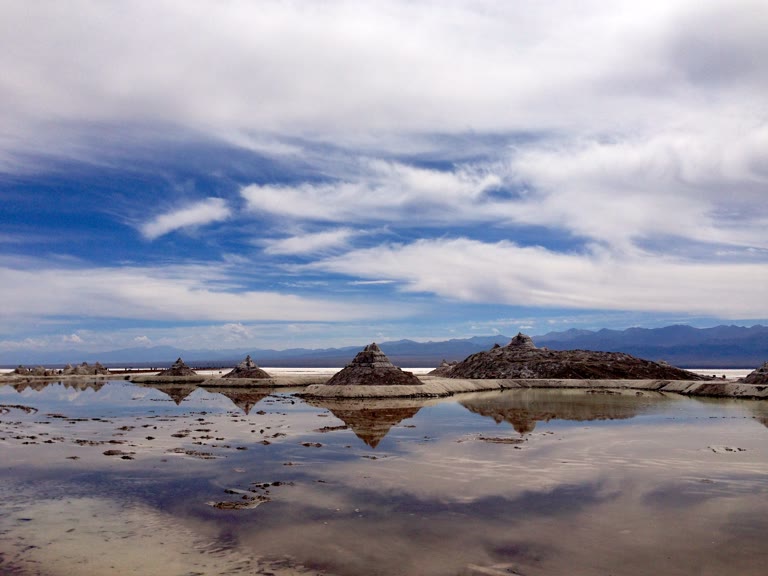
The landscape was once used as a salt field and later developed for visitors. On a clear day, shallow water can reflect clouds, sky and distant mountains; that is the source of its “Mirror of the Sky” reputation. The report also makes the limit visible: the reflection is a condition of light, water and weather, not an attraction that can be switched on.
The field report describes a scenic area large enough for a return journey of roughly 8–10 kilometres. Its practical choice was the small train: the old salt-transport railway now carries visitors deeper into the lake, with classic red carriages and several other colours. The account recorded 22 trains in operation at the time.
The source listed the train at CNY 50 one way or CNY 100 return and an electric cart at CNY 5 one way. Those figures were reported on 10 July 2026 as a dated field note and may change. Recheck current operation, boarding points, availability and fares before building the day around them.
Near the entrance, the report stopped at a salt-sculpture park and the Chaka Salt Station area. The sculptures referenced the Queen Mother of the West, Genghis Khan, the Silk Road and an older salt route, turning the mineral landscape into a short visual introduction before the train journey.
This first area is useful context, but the source found the most convincing reflection scenes farther inside. If photography is the priority, do not use all your time near the gate; decide how deep you want to travel and how you will return before stopping at every installation.
The report's preferred photo area was a deeper section with a snowflake-shaped platform and a view toward the surrounding mountains. It also noted paid photographers around a balloon-shaped installation. Treat those as optional services whose current price and operation need checking on site.
Its most transferable photo advice was simple: lower the camera to strengthen the reflection, place the person slightly above the centre of the frame, and use a clear primary colour when you want separation from the pale water and sky. None of these choices can manufacture a mirror on a windy or overcast day.
At about 3,100 metres, the source recommends walking slowly, resting and drinking water rather than rushing between photo points. It also lists sunglasses, sunscreen and a light windproof layer or scarf as useful preparation for the bright, exposed landscape.
For entering designated shallow-water areas, the report rented protective brine overshoes for CNY 10 with a CNY 50 deposit. That was a dated on-site experience, not proof that the same rental or access rules apply now. Confirm where entering the water is permitted and what footwear is currently required.
The Korean report was published on 10 July 2026 and recommended June through September, especially July and August, for the summer journey it experienced. It recorded an admission snapshot of CNY 60 from May to October and CNY 30 from November to April, alongside the transport and overshoe prices above.
Use those numbers to understand the shape of the day, not as a checkout total. This guide preserves the source's route, observations and date while removing personal imagery and sponsor promotion. Before travel, verify current admission, internal transport, water access and weather for the day you will actually visit.
Questions before you go
Can I visit Chaka Salt Lake as a day trip from Xining?
The source reached it after roughly four hours by road from Xining and combined the corridor with Qinghai Lake. That makes for a long day. Confirm the real return time, driver or tour arrangement and meeting points for your date before treating it as a simple day trip.
When did the source recommend visiting Chaka Salt Lake?
The Korean field report recommended June through September and highlighted July and August for its summer experience. Weather and reflection conditions still vary, so the recommendation does not guarantee clear skies or still water.
Do I need the small train at Chaka Salt Lake?
Not necessarily, but the source described a return distance of roughly 8–10 kilometres and found the train practical for reaching the deeper lake area. Check current routes, queues, boarding points and fares before deciding.
Can visitors walk into the water for reflection photos?
The source used rented protective overshoes in an area where shallow-water access was available. Access rules can change. Follow current on-site instructions and confirm where entry is permitted rather than assuming the whole lake is open to walking.
How current are the ticket and transport prices in this guide?
They are a source snapshot reported on 10 July 2026: admission, train, cart and overshoe figures may change. Recheck the current scenic-area information or your direct operator before travel.
How this page is reviewed
This planning guide is adapted by our China-based team from the dated Korean field report shown below. We preserve its route, observations and publication date, remove personal imagery and sponsor promotion, and label every detail that needs checking for your dates.
Last substantive review: .
Sources and image credit
This page is adapted from the dated Korean field report below. The photograph comes from a separately licensed public source.
- Korean travel field report — Qinghai and Chaka Salt Lake, published 10 July 2026
- Hero photograph — Chaka Salt Lake by Zheng Zhou (Wikimedia Commons, CC BY-SA 3.0)
Treat dated prices and first-hand observations as a source snapshot. Recheck live arrangements before you travel.
Share your dates, group, and the parts of Qinghai & Chaka Salt Lake you want help with. A person reviews every request.